
Is Your Policy Library Ready for Your Next Tender?
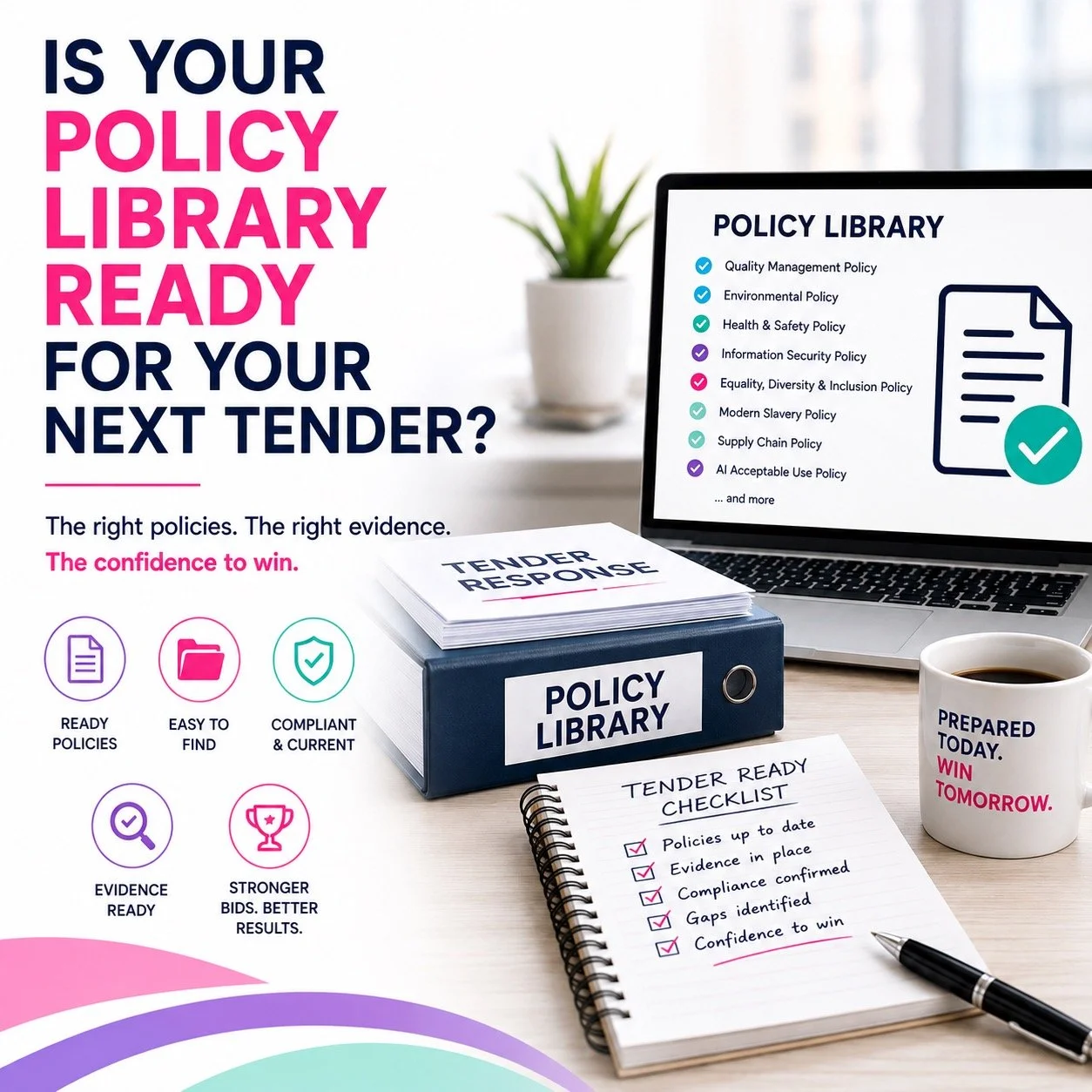
When the next tender lands in your inbox, will your team be ready?
For many businesses, the answer is not as straightforward as they would like. The opportunity may look perfect. The contract value is attractive, the service is a strong fit and the delivery team has the experience to do the work. But then the tender documentation starts asking questions. A lot of them.
Questions about your policy documents, which then starts the scramble and the questioning. “Do we even have a policy on X?” As well as a myriad of questions which start with: “please provide”, “please submit”, “please demonstrate”, “please attach” etc..
Suddenly, the bid team is searching through shared drives, old folders and previous tender submissions. Someone found a policy from three years ago. Another document has the right title but still includes an old company address. A policy that was promised in a previous bid cannot be located at all. And you know it, a significant amount of time is being spent simply trying to work out what policies the business actually has.
This is why your policy library matters.
A policy library is more than a folder of documents
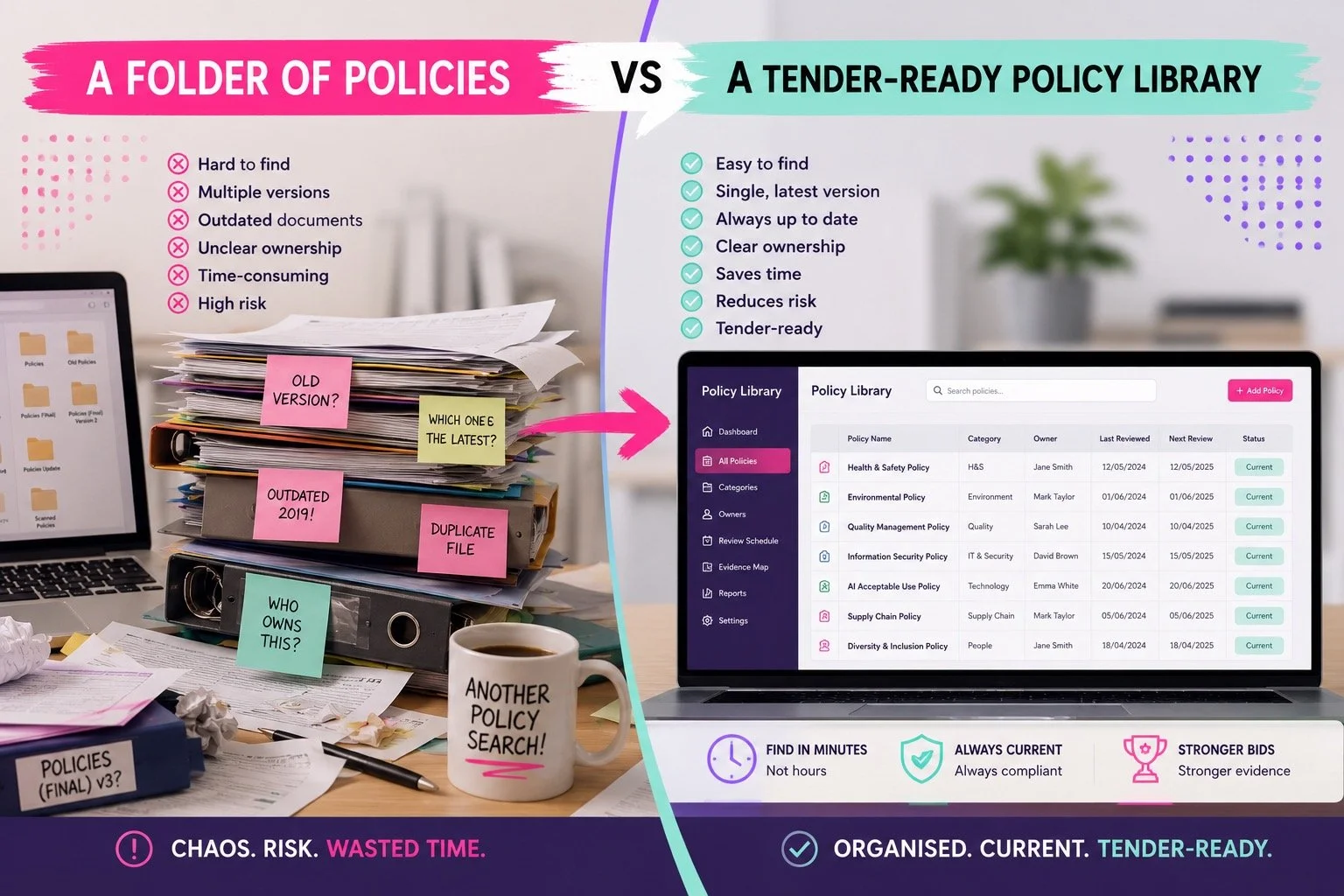
Many organisations believe they have a policy library because they have a folder labelled “Policies” somewhere on their server. But having documents and having a tender-ready policy library are two very different things.
A tender-ready policy library should give your business confidence that the documents you need can be found quickly, reviewed easily and submitted when required. It should provide a clear picture of what policies exist, when they were last reviewed and where they can be used as evidence.
Without this structure, every tender can become a mad scramble. Often a business has policies which are unmanaged, written by different people at varying times. This means there is no order, so often you are sending documents out which are simply not fit for purpose. Your bid response might be great, but your supporting document - maybe not?
All of this creates risk and ultimately shows how you operate as a business: disorganised and last minute. Create a policy library which truly reflects the greatness of your business. In the last 15 years working in bids & proposals, I have only worked with one business who truly excelled in this area.
What happens when a tender exposes gaps?
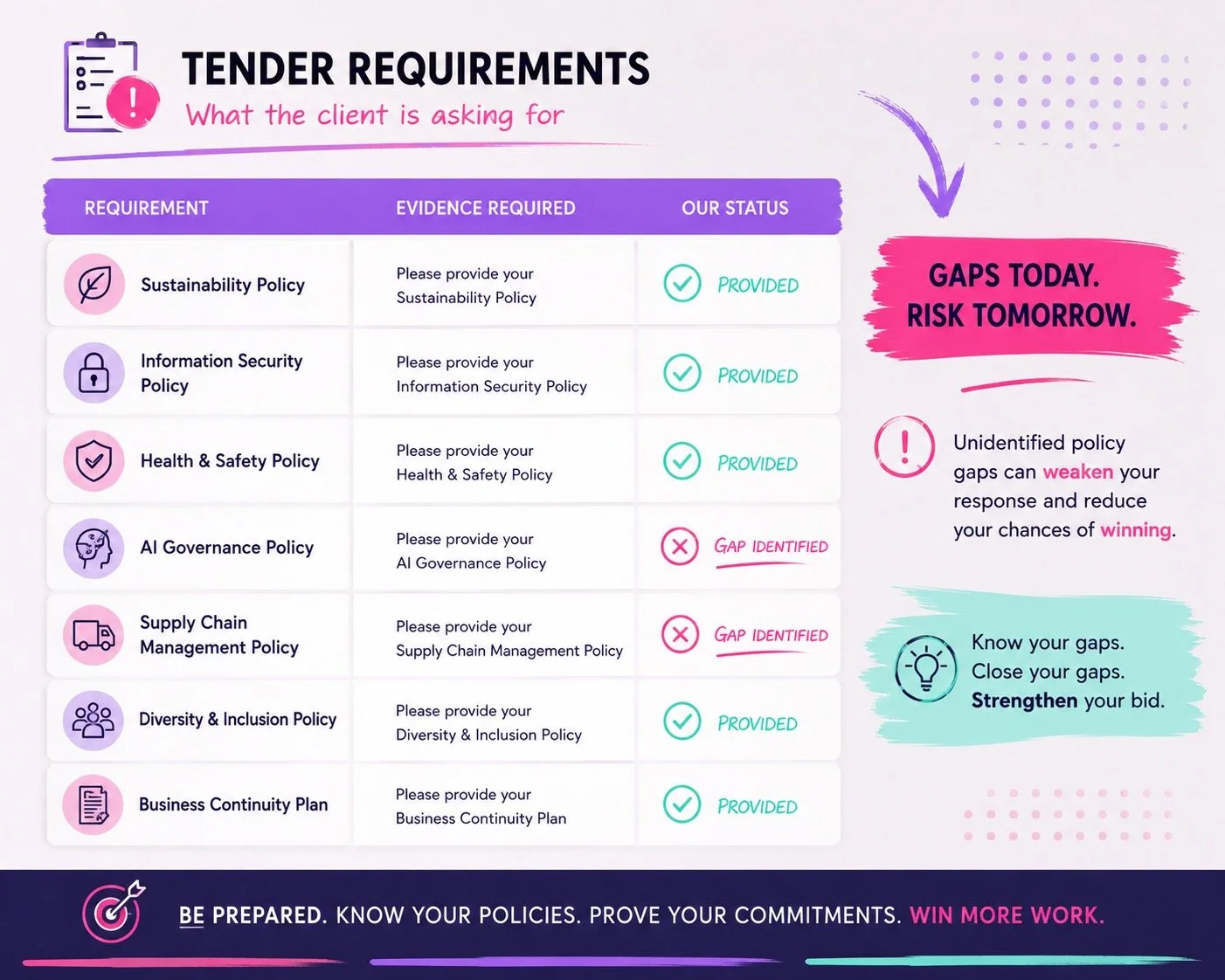
Tender requirements can be unpredictable. One client may ask for standard policies, while another expects evidence covering areas such as sustainability, social value, AI, supply chain management or information security. If you only start thinking about your policies when the tender is released, you're on a hiding to nothing. Producing anything well with a tight timeline is going to be very difficult.
This is when you start producing a document, just for the sake of having one. Rushed documents created simply to fill a gap are rarely your strongest evidence. A policy needs to be credible, reflect how your business actually operates and be supported by proof. If you say you have a process, provide training or monitor performance, you need to prove it. This is where your policy library and tender evidence need to work together. Doing only one of these things well, will rarely seal the deal.
Your policies are part of your bid evidence
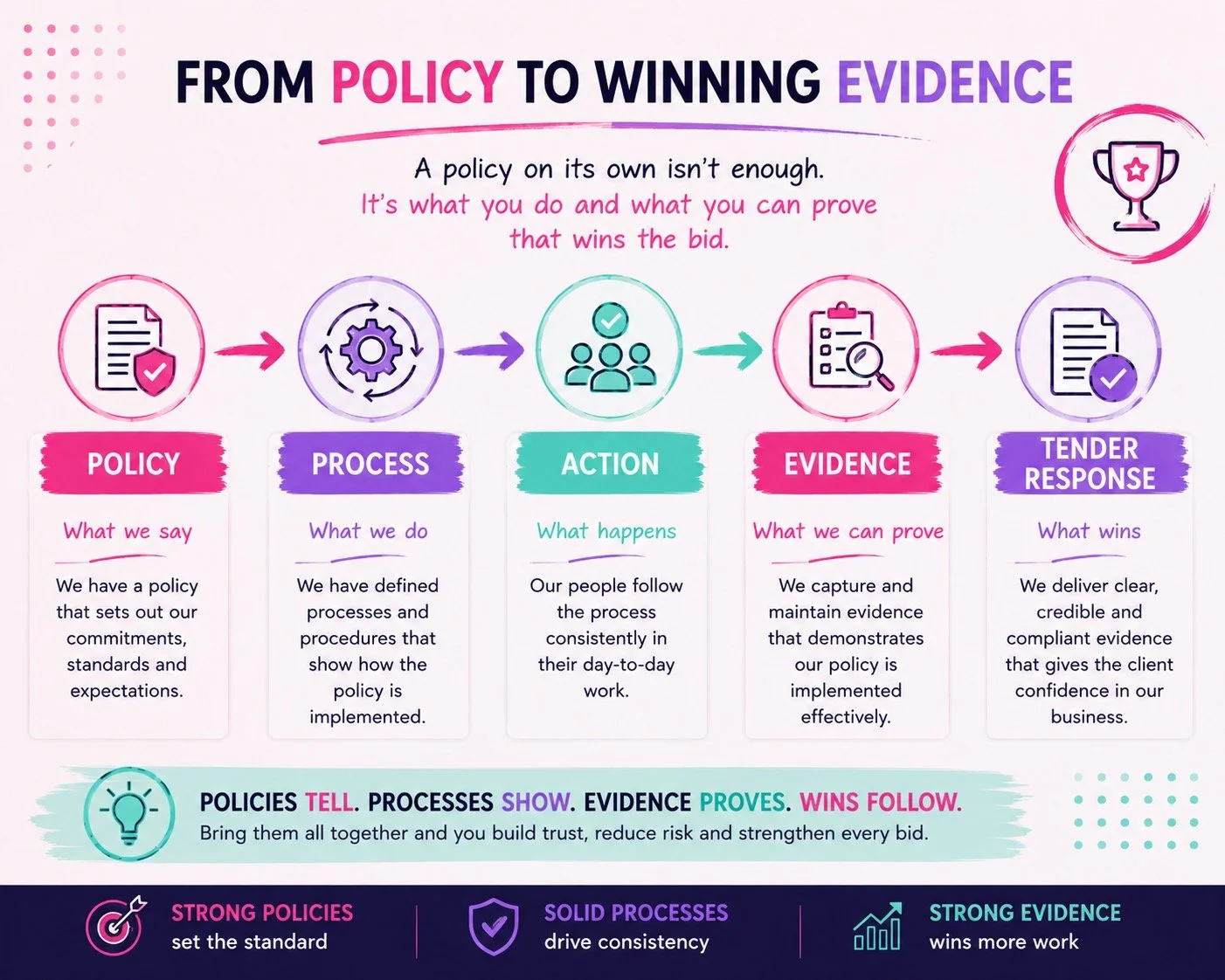
A strong tender response is built on proof, and a lot of this proof comes from your policy documents, or at least it can if you let it. Policies should not be some templated document. Instead they should be a descriptive document which tells the prospect exactly what happens in your business. By whom, when, what actions are taken and more.
Policy documents can then demonstrate that your business has shown governance, defined responsibilities and other commitments in key areas of business. A policy on its own is rarely enough.
But written well with sufficient detail and used part of the wider evidence system, it can become a winning component.
For each important policy, you should be able to identify:
What the policy covers
Which tender requirements it could support
Who owns the document
When it was last reviewed
What procedures or processes sit behind it
What evidence demonstrates the policy is implemented
This makes a huge difference when a tender arrives. Policy documentation becomes a priority because it is one of the few things which can be prepped ahead of time, especially when we know that certain policies are essential criteria and will be asked for. The team are then in a position to consider how to position the response for a particular client. This is then a much stronger place to start.
The hidden cost of starting from scratch
Bid teams are often under pressure to improve the quality of their responses while reducing the time it takes to produce them. Yet many organisations repeatedly waste valuable bid time recreating information they should already have. The same is true for the policy documentation which they know is essential criteria every time.
It is easy to get into a mess with a lot of this stuff though. Multiple versions of the same document. No given owner. Outdated legislation. A central, well-managed policy library helps to prevent much of this. Once you have an owner for this area of governance within your business, many things start to run a lot easier. Making consistency second nature across all areas of bids, proposals, client onboarding and business operations overall.
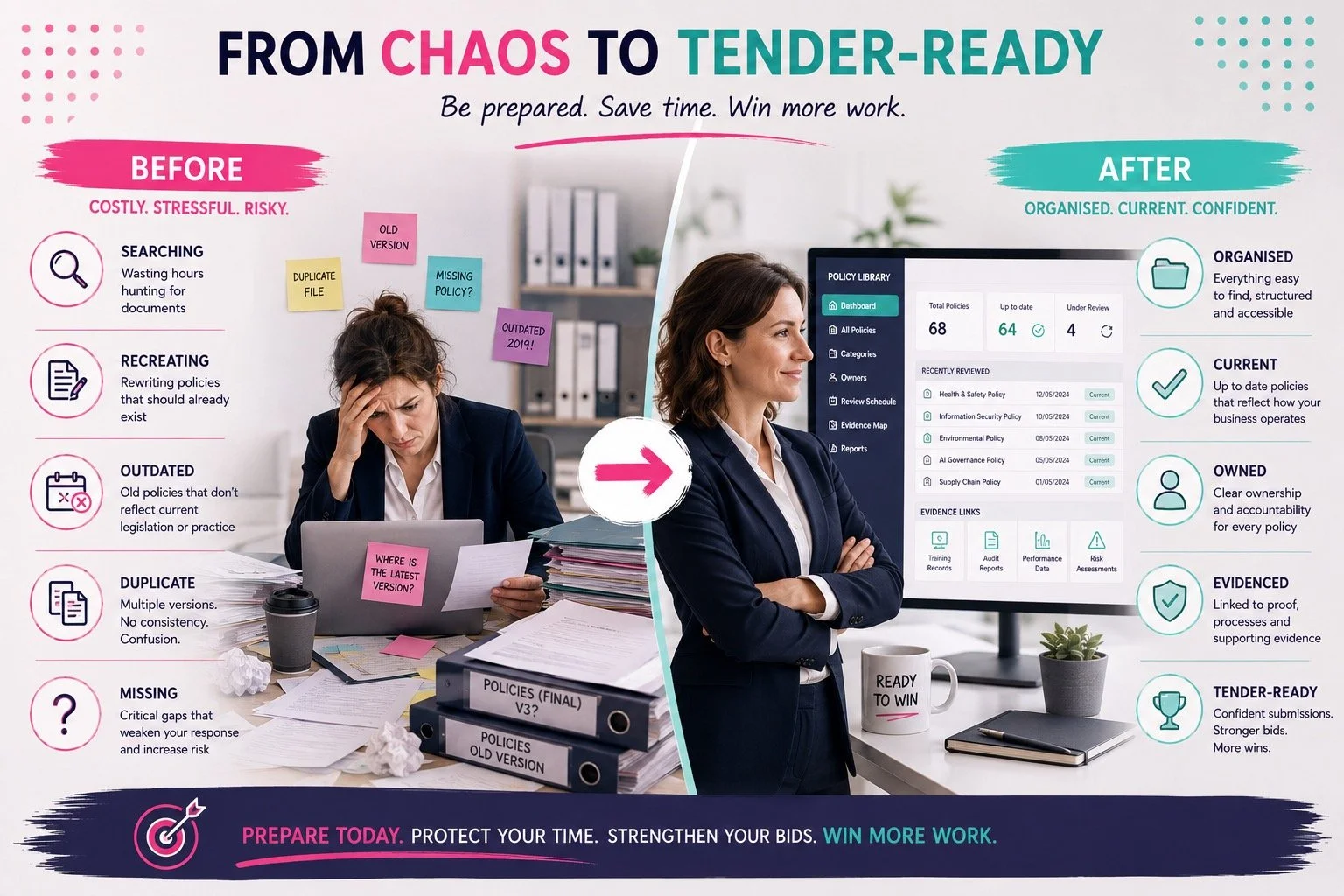
So, is your policy library tender-ready?
Ask yourself: could your bid team find every key policy within minutes? Do you know which documents are current, who owns them and whether they genuinely reflect how your business operates?
Just as importantly, can you quickly find evidence to support the commitments made in each policy, and have you identified any gaps before they appear in a live tender? If the answer is “no” or “I'm not sure,” your policy library may need attention before your next major opportunity arrives.
Prepare before the opportunity appears
The best time to prepare your tender evidence is before the tender lands, not when the submission deadline is approaching. You need a business owner for this area of governance, in the same way you would manage insurances or certifications. It matters just as much. A structured policy library helps you identify gaps early, involve the right people and ensure your documents genuinely reflect how your business operates. This might often be the difference between a win or a loss.
Your policies may not win the tender on their own, but missing, outdated or unsupported evidence can weaken your position. I have seen many opportunities lost when out of date, out of region or out of context policy documents have been sent. Before the next opportunity arrives, ask yourself: Can you find what you need? Is it current? Can you prove it? If not, now is the time to get bid-ready.