YOUR POLICIES MIGHT BE COSTING YOU CONTRACTS
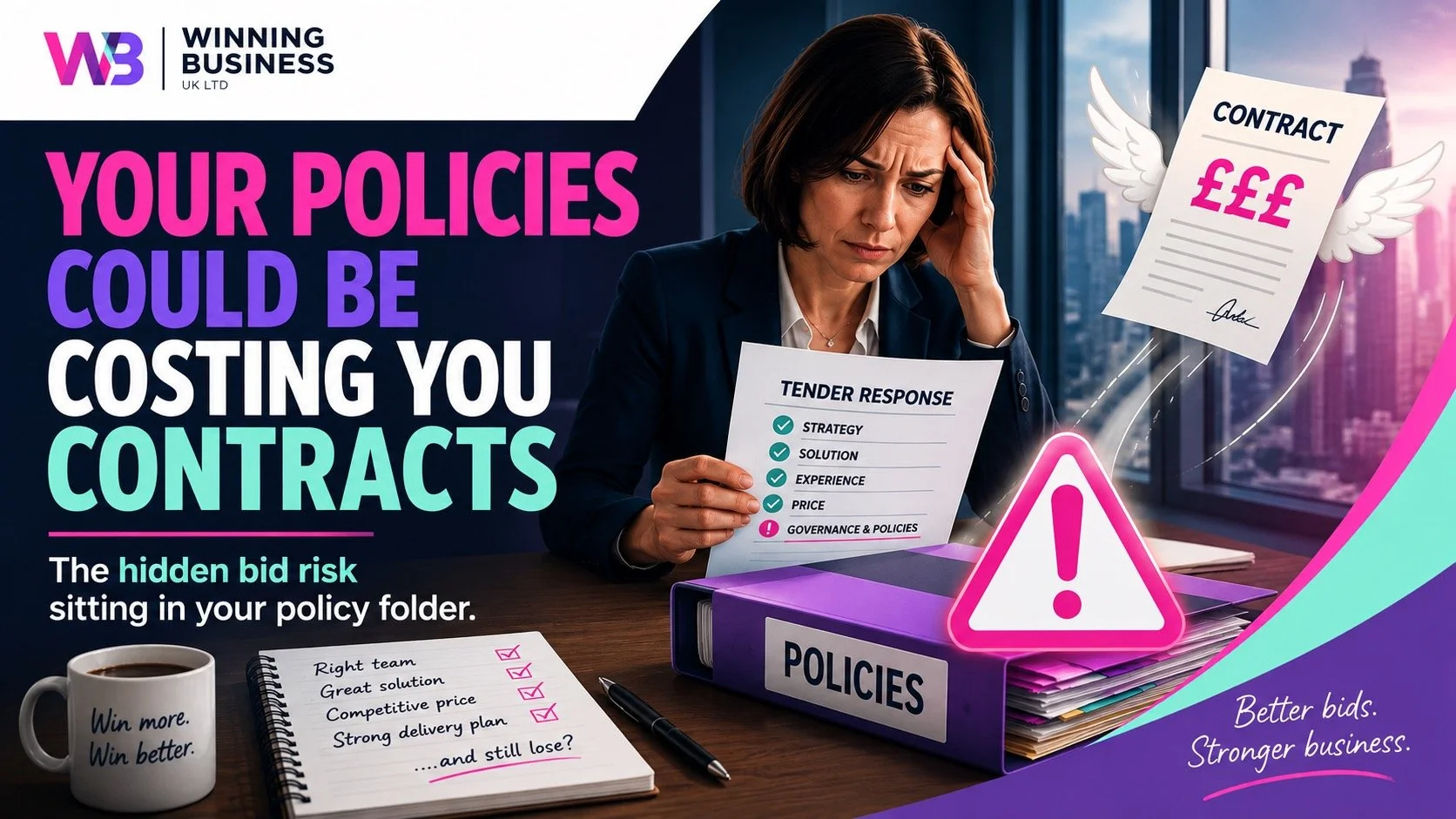
There are so many things which go into making a successful opportunity a reality. Great strategy, competitive pricing, compelling solution, the best team. And usually they all carry their own weight. You can’t have one without the other and all of these can only be created once you receive the details of the opportunity.
But there is one element which people overlook - and that is policy documents. An essential component in every bid and tender. Which when written properly can sell your business time and time again, well before the RFP drops. Because often your policy documents don’t show the proof points your buyer is looking for. And this then results in a “no win”.
Policies are often one of the most overlooked parts of the bidding process. They're filed away somewhere in the business, occasionally updated, and largely forgotten about — until a tender asks for them. This is the wrong approach by far. When there is nobody managing these important compliance documents, it can be a recipe for disaster. They are not updated or considered, yet you still send them out with every opportunity, never considering how they represent your business. And this when they become a “bid problem”.
Policies aren't just corporate paperwork
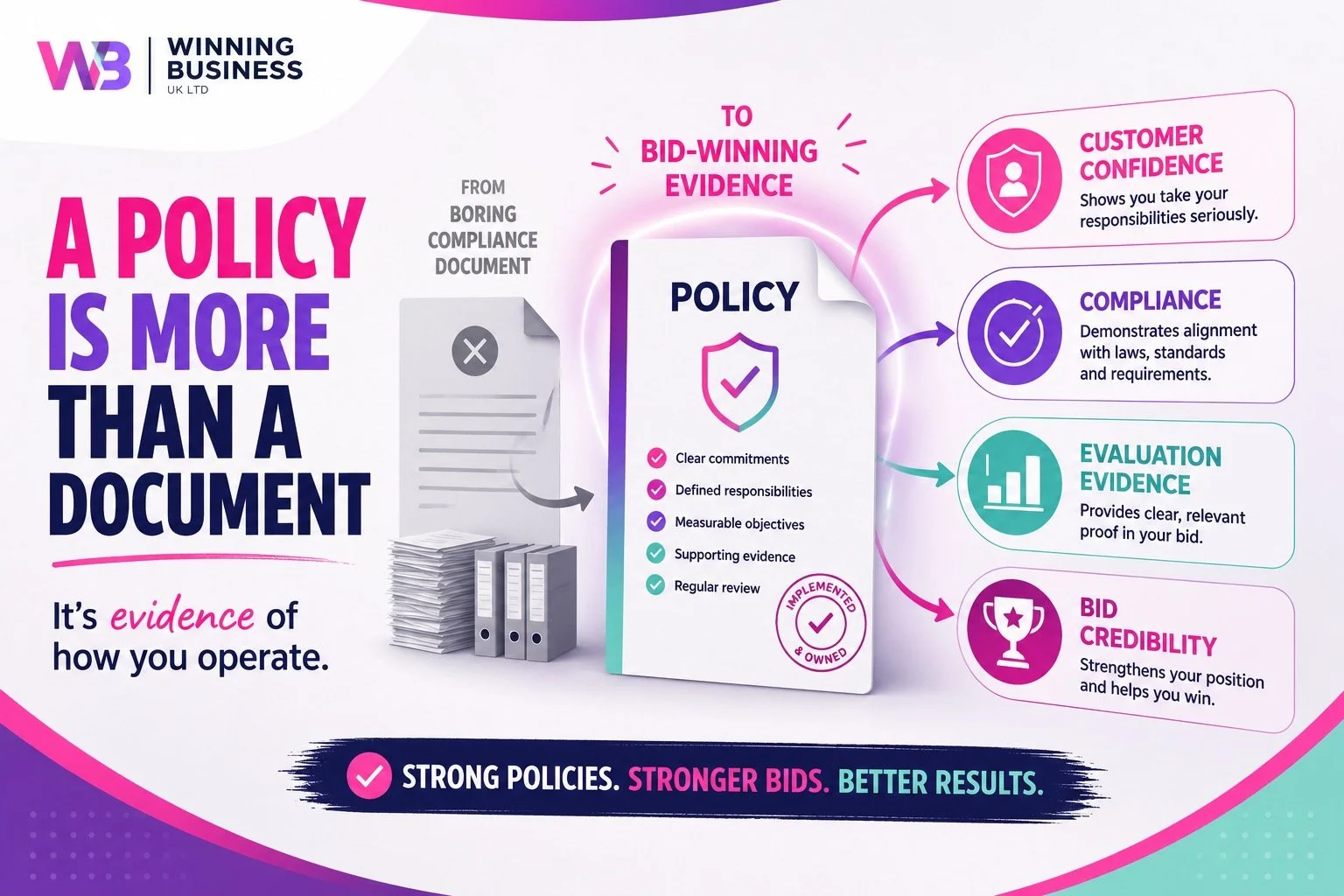
For many businesses, policies are treated as something you need because you're "supposed to have them". Just another compliance document. Often wrapped up in a HR function, when realistically they are a huge part of Business Development operations.
When we think about a competitive procurement process, policies can play a much bigger role. I always say policy documents provide “a window into your world”. A prospective buyer realistically wants to know how you work, processes you have in place, how you handle problems, and more.
What better way to demonstrate this than through your policy and control documents. If you have a stack of resources which relate to standard operating practices, method statements, training logs, as well as thorough documentation on policy matters, you are already ahead of everyone else.
But just having a policy isn’t enough on its own. It is a bit like giving a one word answer to an RFP question, when the buyer is looking for a lot more context. Detail is required.
A Bad Policy IS Worse Than No Policy at All
Imagine you're an evaluator.Having to take time out from your day job. 2 days in a windowless room on a gloomy day in Birmingham (no offence Brum). You’re reviewing responses from five suppliers. Four of them tell you about their commitment to sustainability.
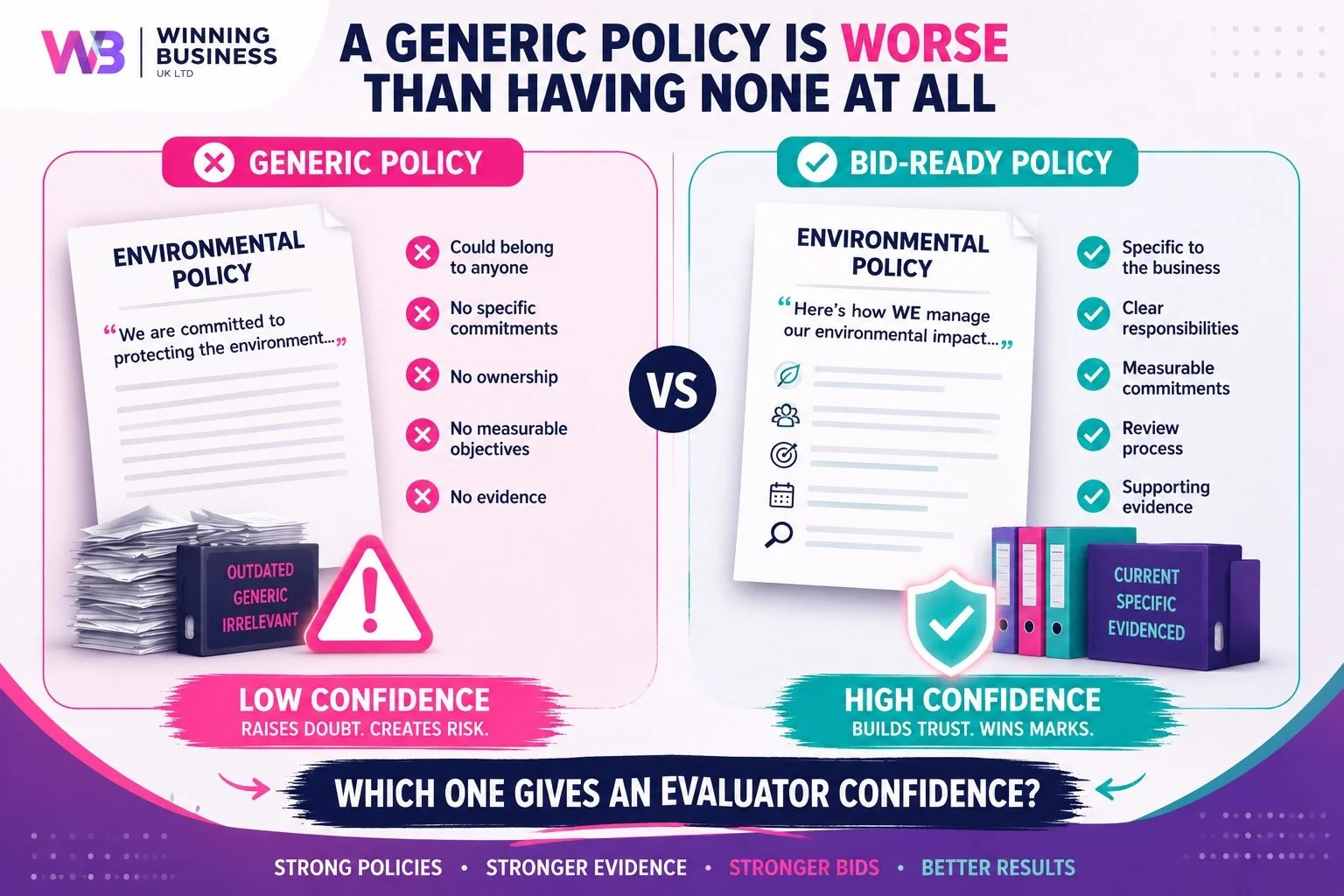
One of them provides a detailed, specific explanation of how it manages environmental impacts, backed up by its Environmental Policy, objectives, responsibilities and evidence.
Another simply uploads a document called: Environmental Policy.pdf You open it. It's two pages long with the usual broad statements about "minimising environmental impact" and "complying with all applicable legislation". That's it.
Who are you going to choose? Because policy documents add as much weight as the bid response itself. The problem with generic policies is that this is often all they are. Generic. And where does a generic bid get you? Nowhere. Experienced evaluators can spot this a mile off, just as I can read a response and spot all the glaring errors because I am also experienced at this game.
A policy that could belong to any company in any industry doesn't tell your buyer anything about your business. And that kinda defeats the point.
Outdated policies create another problem
Outdated policies can be an absolute deal breaker. Many buyers will stipulate exactly what they want and if they don’t receive it, it's game over. That simple. Nobody is coming back to you to chase up missing paperwork. I worked with a client a couple of years ago, through my Bid Strategy Session, where I was helping them to understand why they had been unsuccessful. One of the many reasons was sending documents which were both out of date and for another region. What people think of an admin error or lack of attention to detail can cost you big.
I say it a lot, but nobody is here to hold your hand and guide you. This is a business transaction. If you can’t attach a valid document, which is a very simple instruction, what else can’t you do? The buyer is watching and you just failed the first hurdle.
Think about it. Your Environmental Policy references objectives from four years ago. You talk about your use of AI, but you don’t have an AI Acceptable Use Policy - so what are you measuring this against? All of these inconsistencies create doubt, and this is the last thing you want when you’re trying to win high-value work. The evaluator doesn’t know you and can only assess you based on the level of information you provide. If your documentation suggests that your policies aren't actively managed, they may reasonably question whether the practices described in your bid are actually embedded in the organisation.This then becomes the difference between a win or a loss.
“We’ll Write One If They Ask” Is Already Too Late
I've seen this mentality many times. Worked with clients and in-house where it happens until I step into the room. A tender lands. Someone looks through the requirements. They discover the customer wants a policy that doesn't exist. So someone is given two hours to write one. I’ve been in this position many times in my career, which is why I created my Bid Policy Toolkit to address this issue.
These documents created in this way will always be sub-par. They are rushed, generic, poorly formatted, disconnected and just inconsistent in general. At the start of my career, we used to have these people called “policy writers” who seem to have died a death, but policy documentation is as important as it has ever been.
Your policy library should be ready before the tender arrives. It needs to be given the same importance as anything else. A poorly run organisation is one which doesn’t win work, but is the first to complain why not? It usually in my experience comes from poor leadership with a lack of docs on what it actually takes to win work at this level.
What makes a policy bid-ready?
A good policy should do more than fill a folder. As a minimum, it should be all of these things:
Relevant
Specific
Owned
Current
Implemented
Evidenced
And most importantly, your policies should align with your bid narrative. It goes without saying really. If your bid says one thing and your policy library says another, you've created an avoidable credibility problem. Which is so very easy to fix.
Your policy library is part of your bid infrastructure
The bid library or knowledge bank is an essential part of the winning work process. But people still don’t take this seriously. As if all of this information just appears by magic. I have been asked more than once something along the lines of “if you’re answering a bid, what are you doing”?!! Oh I don’t know, preparing for the next one. The same is true for your policy documentation. If the information within these documents does not reflect who you are as a business, how you work or what a future partner can expect from you, there is a bit of a problem.
Organisations seriously need to stop thinking of policies as documents which are there for HR, compliance or procurement. Because it really is so much more than that. They form a crucial part of your bid infrastructure.
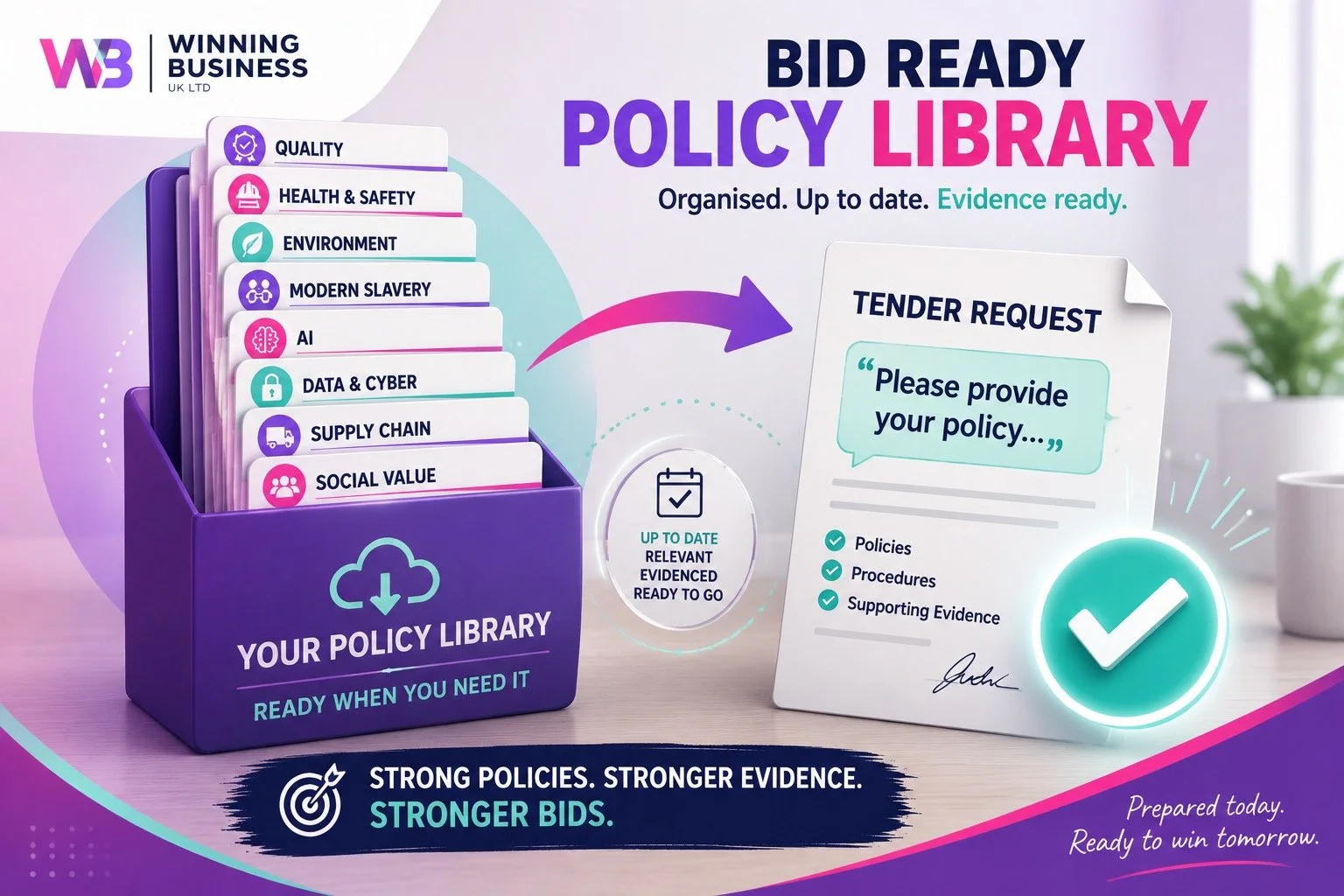
When the customer asks how you manage modern slavery risks, you shouldn't be frantically searching Google for a template. When the bid team discovers that the customer wants evidence of responsible AI use, you shouldn't suddenly realise nobody has thought about AI governance. Your policy library should be sitting there, ready to support the bid. And that gives your bid team something incredibly valuable: speed.
Don't let your policies become the weakest link
Winning contracts isn't just about writing better answers. It is very much about having the organisational capability and evidence to support those answers. If you don’t have a system in place, you have already lost.
Weak policies can make a strong business look immature.Just as generic/boiler plate policies which give basic compliance info whilst not saying anything just look superficial. But in terms of getting your business “bid ready” this is also one of the easiest problems to fix. You can take action today.
Start by auditing your policy library, identify gaps, decide what needs updating and create those frequently requested documents to the best of your abilities. The question you should be asking yourself is: "Would our policies give an evaluator confidence that we're ready to deliver this contract?" If the answer is "I'm not sure", you've probably found a bid risk worth fixing.And possibly one that's costing you more contracts than you realise.
Want to get your policy library bid-ready?
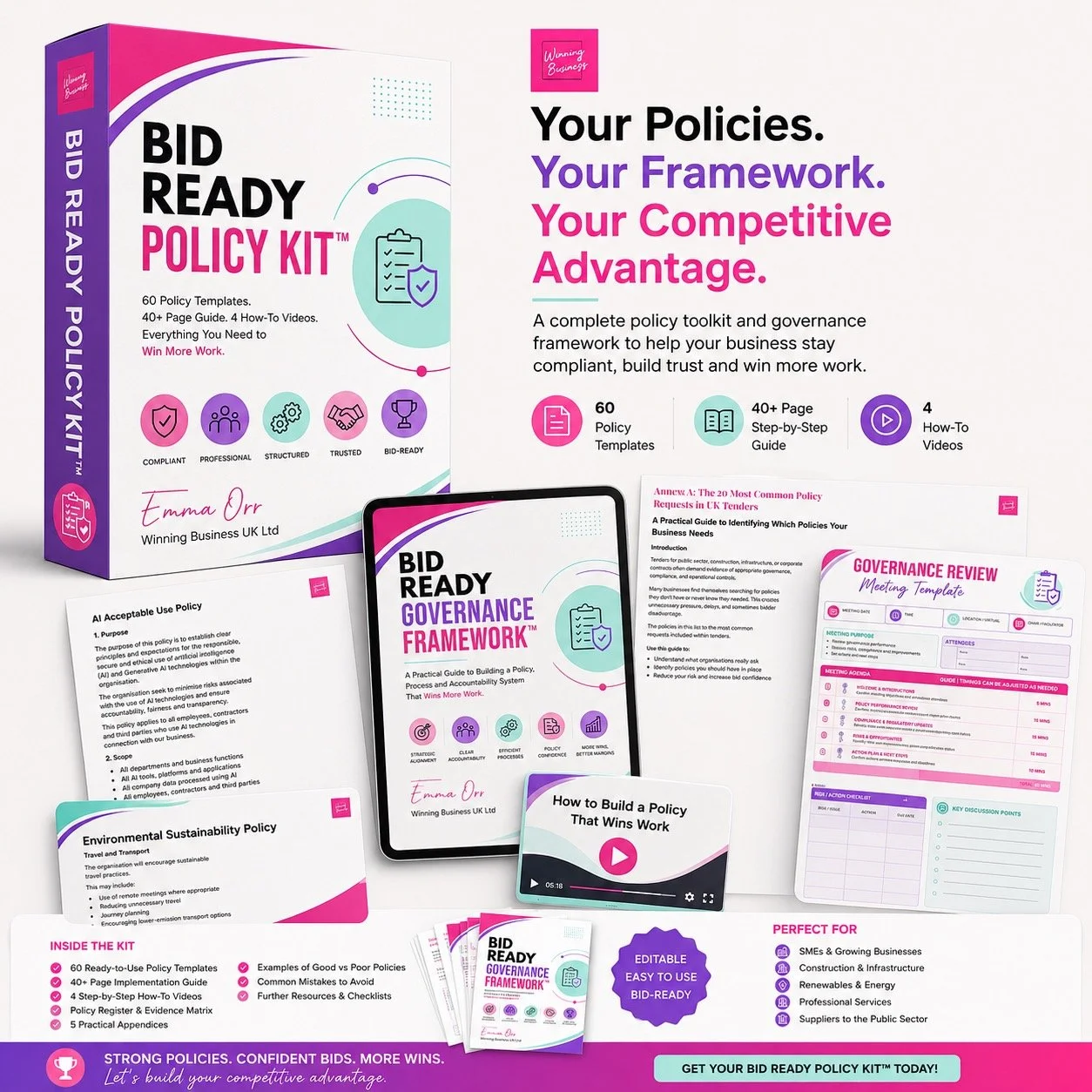
That's exactly why I created the Bid Ready Policy Kit™.
It gives SMEs and growing businesses 60 ready-to-use policy templates, alongside a practical user guide, tender evidence matrix, policy register and supporting resources — so you're not starting from a blank page every time a tender asks for evidence.
Because your policies shouldn't just sit in a folder.
They should help you win.